Hand reading, chiromancy
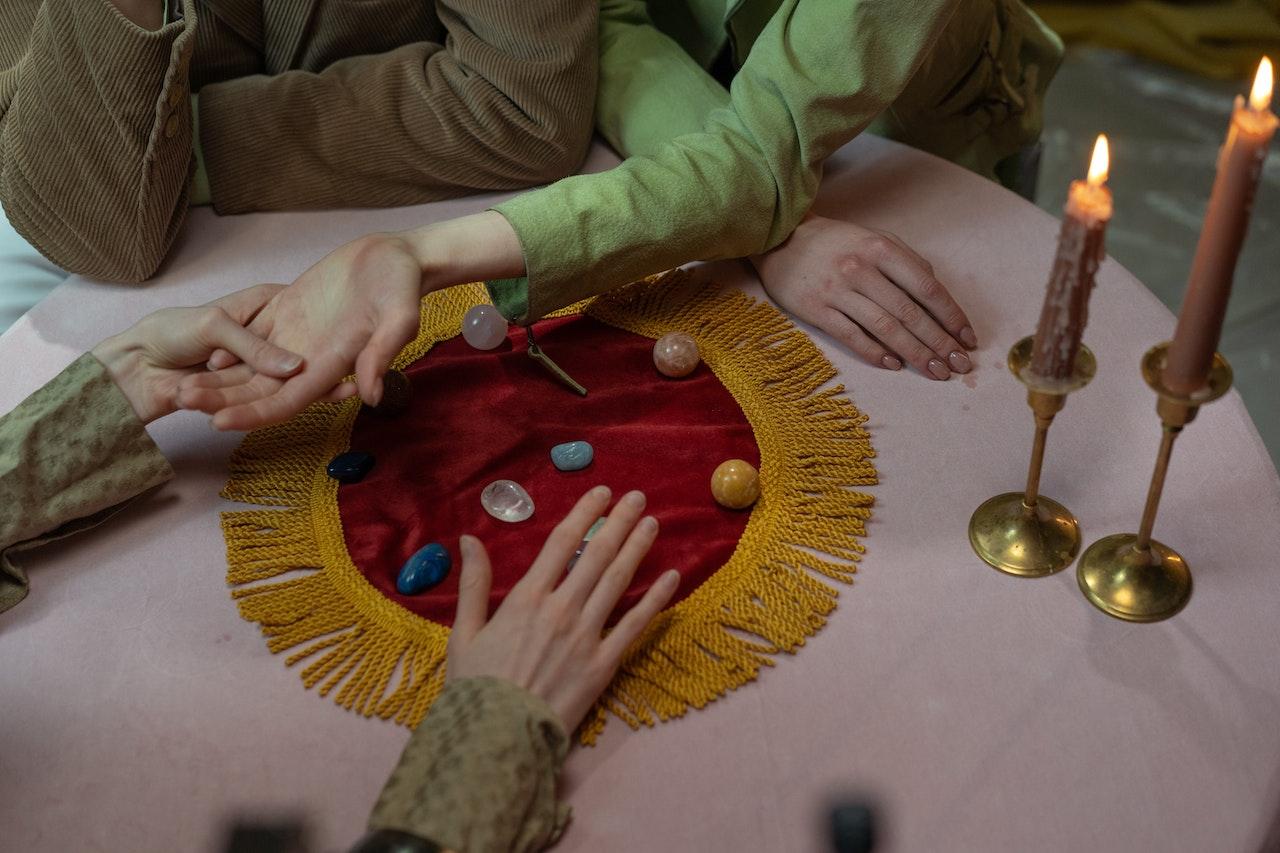
Quick answer: Hand reading — also called palmistry or chiromancy — is the practice of interpreting the lines, shapes, mounts, and texture of the hand to draw out something about a person's character, tendencies, and possible directions in life. Reputable readers treat it as a reflective tool, not a forecast. The hand is read as a kind of map of the patterns the person already carries.
Where it comes from
The practice has been around for thousands of years. In India, palmistry dates back to the Vedic period (1500–500 BCE) where it was used to assess an individual's character and destiny. In ancient China, hand reading was an important part of fortune telling, and in medieval Europe it was practiced by traveling Romani readers, where it picked up much of the imagery the West still associates with palmistry today.
In the 18th century, the French physician and occultist Comte de Saint-Germain popularized the idea that the lines and features of the hand could be read to predict the future. He developed a system of palmistry built on the belief that each life was patterned and that the markings of the hand reflected that pattern. In the 19th century, palmistry was further developed by occultists like William Benham and Cheiro, who made it more accessible to a general audience and codified much of the modern reader's vocabulary.
By the 20th century, palmistry was widely accepted in popular culture as a valid means of self-reflection. Today, modern palmistry focuses on interpreting the lines, shapes, and mounts of the hands to gain insight into personality and possibilities — while reputable readers note plainly that it is not an exact science and should not substitute for professional advice.
What a reader actually looks at
A modern reading is structured around a few elements:
- The dominant hand carries the person's active life — what they're doing now and what they've shaped.
- The non-dominant hand carries the given — temperament, inherited tendencies, the raw material.
- The four major lines — life, head, heart, and fate — show the texture of those domains rather than literal events.
- The mounts — the small fleshy areas under each finger and the base of the thumb — map to planetary energies (Venus, Mars, Jupiter, Saturn, Sun, Mercury, Moon).
- The shape of the hand — earth, air, fire, water — places the person in a temperamental family.
What the four major lines mean
- Life line — vitality, energy, how grounded the person feels in their body. Not a literal lifespan; a long line is not a long life.
- Head line — how the person thinks. Straight = analytical, curved = imaginative, deep = intense, faint = scattered.
- Heart line — emotional life. Where it starts and ends says a lot about how the person loves and what they expect from love.
- Fate line — the relationship to work, vocation, and the sense of being on or off track. Some hands have it, some don't, and that's information too.
When palmistry is useful — and when it isn't
Hand reading is best at clarifying patterns the seeker already half-senses about themselves: a tendency, a default reaction, a place where they tighten up. It's poor at literal prediction — will I marry this person, will I get this job — and any honest reader will reframe such questions into ones the hand can answer well.
Related terms
For other reflective divinations, see Tarot, Crystal ball, and Tea leaves. For the broader celestial framework that names many of the same energies as palmistry's mounts, see Astrology.
---